
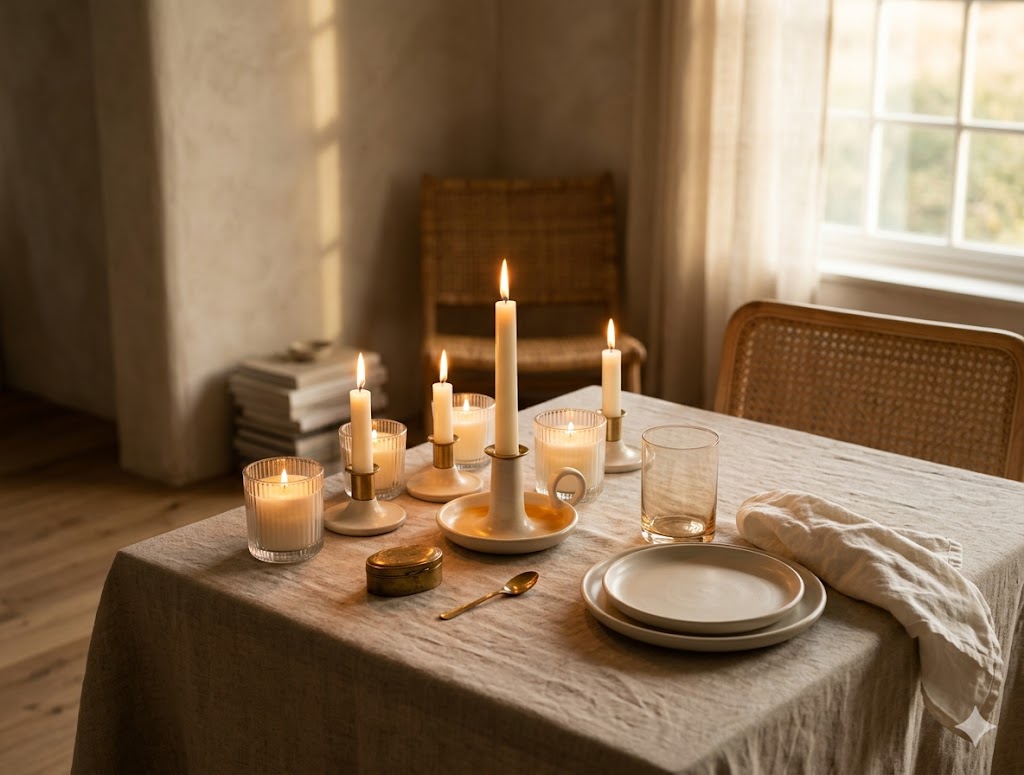
There is a moment, somewhere between clearing the table and sitting back down, when the day is no longer the day. You strike a match. The wick catches. And the room rearranges itself around a single point of light. This is not ambiance — or not only that. It is a signal. The tasks are done. The evening has arrived. We have always believed that a candle is less a product than a practice, a small ceremony that asks nothing of you except to pause.
We keep five candles in rotation through the warmer months, each one suited to a different hour or a different room. The first is beeswax, unscented, for the dinner table. It does what a candle should do at a meal — it gives the faces around the table something warm to lean toward without competing with the food. Beeswax burns slower and cleaner than paraffin, and it carries its own faint sweetness, like honey left in a warm cupboard. No fragrance needed. The flame is enough.
After dinner, the mood shifts. A cedar candle in the living room draws the outdoors in — resinous, dry, a little smoky, the way a campfire smells from a distance. Cedar works in summer because it doesn’t try to warm the room. It deepens it. Then there is the fig candle, which we think of as a bath candle, though it works just as well on a nightstand. Fig is green and milky and slightly sweet. It smells like shade. For the porch, we lean toward soy — a clean burn, a gentle throw, nothing that overwhelms the jasmine coming off the railing or the particular stillness of a July evening at nine o’clock when the sky is still not quite dark.
The difference between soy and beeswax is worth understanding, if only because it changes what a candle asks of a room. Soy is democratic. It burns evenly, holds fragrance well, and produces almost no soot. It is the quiet candle, the one that works in the background. Beeswax is older and stranger — its flame flickers differently, its light is yellower, and it carries a presence that feels almost geological. We stock both because they serve different evenings. A Tuesday in May calls for soy. A Saturday in August, with the windows open and nowhere to be, calls for beeswax.
What interests us most is the geometry. Set a candle on a low table between two chairs and watch what happens. The conversation draws inward. People lower their voices. The circle of light is only three or four feet across, and everything beyond it becomes peripheral — the bookshelves, the kitchen counter, the day you just had. A single candle on a porch can do something similar, pulling the whole evening into a small, warm radius while the rest of the yard goes blue and then black. It is a remarkably simple technology for changing how a space feels.
We chose these five not because they are the best candles — that kind of ranking misses the point — but because together they cover the range of evenings a summer can hold. The quiet dinner. The long bath. The after-party wind-down. The porch with a book. The night you light something just to watch it burn. Each one is an invitation to stay a little longer in the moment you are already in. That is what a good candle does. It does not transform the room. It reveals the room you were already sitting in.
Shop the Story
Charcoal Scented Candle → Ptolemy Aromatique Candle → Nouvelle Vague Candle → Browse Indoor Living