
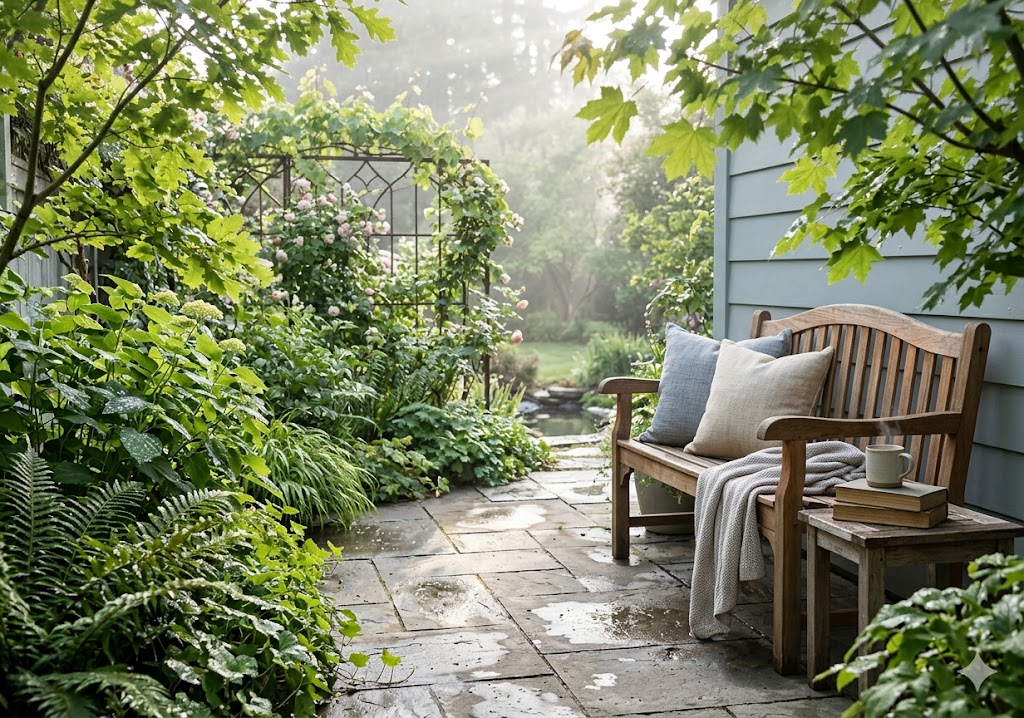
June arrives in Portland the way a held breath finally releases. The rain does not stop so much as forget to come back. One morning you step outside and the air is different — lighter, drier, carrying the smell of cut grass and warm pavement. The sky, which spent five months the colour of wet concrete, turns a blue so specific to the Pacific Northwest that it almost seems invented. It is not the flat blue of California. It is layered, washed, a blue that remembers the grey behind it. By the time you have your coffee poured and your chair pulled onto the porch, you understand that something has shifted. The city is breathing out.
The light is what changes everything. In June, Portland holds onto the sun until nine, sometimes later, and the evenings stretch into long golden corridors that feel borrowed from somewhere further north. You can eat dinner at seven-thirty and still have an hour of warm light on the table. The shadows lengthen but never darken. Trees throw patterns across sidewalks that look like the work of a careful printmaker. It is the kind of light that makes you rearrange furniture, drag a chair closer to the window, eat outside for no particular reason other than that you can. After months of dining under lamps, the return of natural evening light feels almost luxurious.
Saturday mornings we walk to the farmers market. This is not unique to Portland — every city claims its market — but there is something about the way it works here. The vendors are unhurried. The produce is still dirty in the good way, soil clinging to radish bundles and strawberry stems. Someone is selling ceramics from a table covered in linen. Someone else has wildflower honey in jars that catch the light like amber. You buy things you did not plan to buy, not because you are persuaded but because the objects themselves seem right — a bunch of peonies, a small wheel of cheese, a bar of soap that smells like Douglas fir. The market is where Portland’s relationship with materials becomes visible. People here care about what things are made of. They want to know the clay, the grain, the fibre.
The green of this place is difficult to describe to anyone who has not stood inside it. It is not tropical green or manicured green. It is deep, wet, patient — the green of moss on stone, of ferns unfurling in the understory of a Douglas fir forest, of lichen slowly covering a cedar fence. Even in the city, the green presses in. It climbs walls. It fills the gaps between buildings. It makes every neutral — every linen, every clay, every undyed wool — look intentional, as though the objects chose their colours in response to the landscape. This is not an accident. The reason natural materials and quiet colours feel so at home here is that they already belong to this palette. The land arrived first.
We think about this often — the relationship between place and the things you choose to live with. A home in Portland does not need bright colour to feel alive. The life is already outside the window, in the particular green of the yard, in the way the rain has darkened the fence to charcoal, in the vine maple that turns the living room into a lantern every October. What the interior needs is restraint. Warmth without effort. A linen cushion. A stoneware bowl. A low table made from wood that still looks like wood. The objects that work here are the ones that do not compete with the view — they extend it inward, so that the boundary between inside and outside becomes soft, negotiable, almost irrelevant.
June is when all of this becomes obvious. The porch is usable again. The windows stay open. You can hear the neighbourhood — someone’s sprinkler, a screen door, a dog barking three houses down in a way that sounds more conversational than urgent. The coffee is better on the porch, or maybe it is just that you are better on the porch. The city in June is a persuasive argument for a certain kind of living: slower, closer to the ground, attentive to texture and light and the weight of things in your hands. We did not set out to build a store that reflected Portland specifically. But standing on the porch with a warm cup and the long evening ahead, it is hard to imagine we could have built it anywhere else.
Shop the Story
Staffa Coffee Table → Browse Outdoor Living → Browse Summer 2026